REFLECTIONS · NOV 29, 2026 · 12 MIN
OneVault: Coordinating N Projects With AI
We often hear that AI lets one person do the work of a whole team. In my opinion this is partly true, because that one person also becomes the AI team's coordinator, and coordinates alone: there are no status reports, no one keeps track of what was decided, and there is nobody to argue the priorities with, so everything lives in one head (and, at least to me, coordinating was always the more interesting part). Coordinating is a job of its own, whoever does the work, and with AI it does not go away, it just falls on one person.
These days, every morning I open Claude in my notes vault, and before I type anything it already knows where each of my nine projects stands, whether that picture is still current, and whether my plan for the week has fallen behind. When I ask "what should I work on today?", the answer comes from all of them together, not from the one I happened to open.
This is where OneVault comes into play, a small framework built exactly for that, named after the idea behind it, One-to-N: one vault that coordinates N projects.1 I have just open-sourced it on GitHub, and to keep the post structured I am using the 4W + 2H from an older post, i.e., What, Why, Who, When, How and How Much.
What (the subject)
Imagine having multiple projects running at the same time, ranging from coding to website development to blog writing & journaling to keeping notes about your health and more. You need to continuously keep track of them, but also maintain the context about all of them, for example why you started them, what the end goal is, how often you should be working on them, etc. On top of that, you have new projects coming in and the priorities get updated, projects get removed or become stale and other projects suddenly become extremely important. This requires high levels of mental throughput and having someone to bounce ideas off of is highly valuable. These are some of the problems OneVault solves.
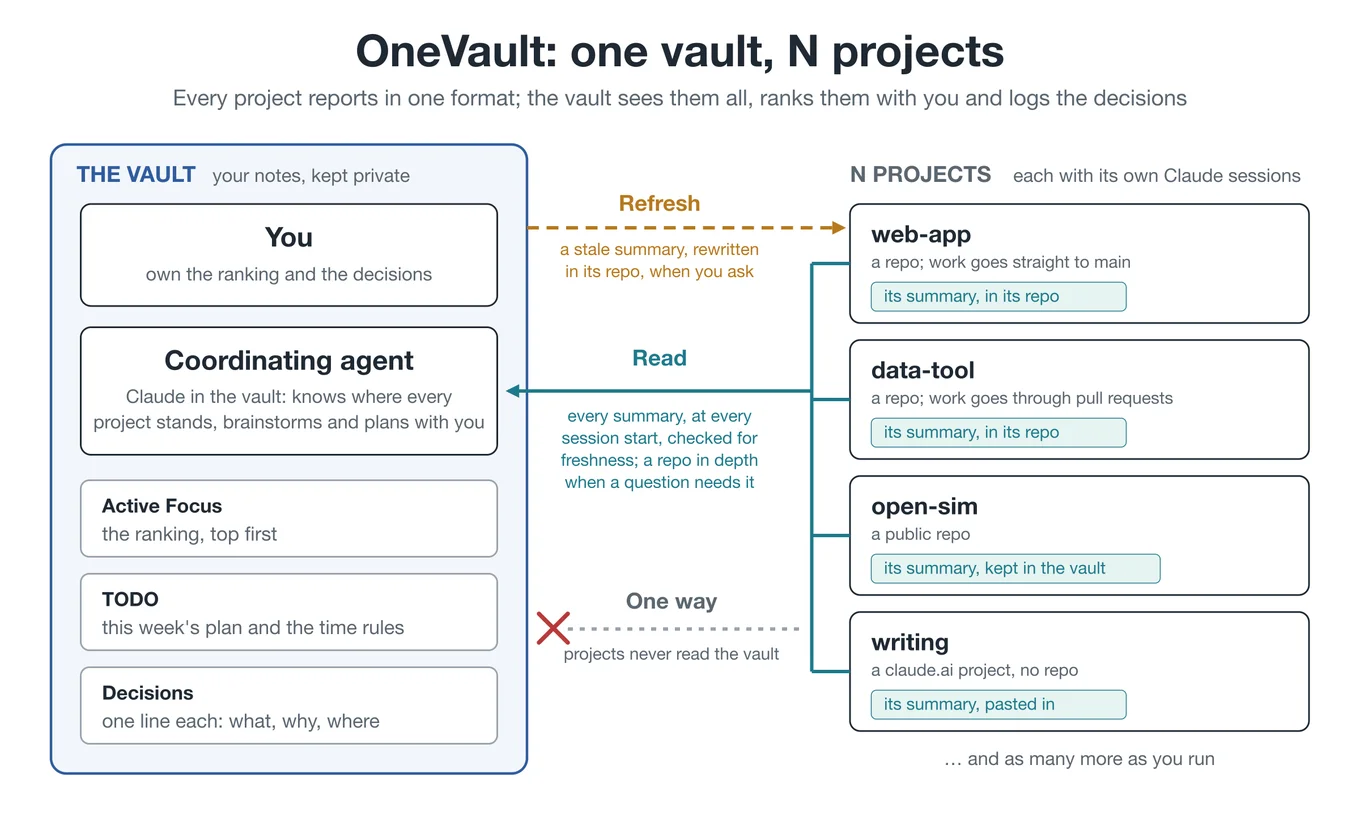
OneVault lets me run all of my projects from one place, which in my case is my notes vault (note: a folder of Markdown notes, kept in a private repo), and the projects are code repos, public repos, and a few projects that live only in claude.ai. The projects do not change shape to fit the vault; each one writes a short summary of where it stands, in one common format, and the vault reads all of them at the start of every session. So every time I start Claude inside my vault, I get an accurate, up-to-date image of where all my projects stand, what I need to do next and why, what my priorities are, and a sanity check from AI whenever I ask for it.
What it has become, at least to me, is closer to a second brain, i.e., a partner I brainstorm with about new projects, about existing ones and about what should come first, which already knows where everything stands before I say a word. For example, every time I asked what I should work on, it started to remind me of work on my blog that was soon due and would become stale unless I worked on it. Similarly, when I was weighing my website and blog against other toy projects like the Nav Stack Lab, I dumped all of my ideas to OneVault, which already knew what projects I had in mind, and it helped me create realistic plans both for my website, my blog, and Nav Stack Lab. It nudged me to finish the website first one step at a time, and then focus on Nav Stack Lab. Also, it asked me questions about what I want to achieve in the near future. The ultimate value test is whether an app you use is the first app you open on a daily basis, and that's what OneVault has become.
Why (the justification)
Claude offers great project isolation and good in-project memory, which is exactly what one needs while building something. On the other hand, nothing looks across the projects, and once there are more than a handful of them several things are missing:
Cross-project management (one view of everything that is running).
Project ranking (which one gets my time this week, and why).
Up-to-date statuses (where each project really stands, not where I remember it standing).
Cross-project context sharing (material from one place reused in another).
Decision logs (what was decided, when, and for which project).
Time management (the week, the slots, the trade-offs).
Without these, I became the only link between my projects. Ever since I moved to managing teams, small or big, my job transformed significantly to working on coordinating the work of my team members or teams, and that required me to be always on top of timelines, deliverables, available resources, technical challenges, budgets, and more. As the number of team members or teams or projects grew, the amount of information I had to maintain and communicate increased significantly. I was carrying the statuses in my head, ranking them in my head, and re-explaining the context every time I switched from one project to another, which is not very different from a manager who has no status reports from the team and has to walk around asking everyone the same questions every week. This is also when I realized that I was becoming a single-point-of-failure (SPOF) and ever since I have been looking for ways to address these challenges, so when LLM agents arrived I hoped AI could be a partner in that work, one that knows the past, present and future of all my work and helps me decide what comes next, and not only a faster way to build. However, none of the tools I tried did that across projects.
Who (the owner)
The framework is for one person running more projects than fit in their head, e.g., founders, managers, individual contributors, consultants or solo builders. Inside the framework, each role owns one thing:
You (the owner): the ranking, the rationale, the decisions and what comes next.
The coordinating agent (Claude in the vault): reads every summary, brainstorms and plans with you, and opens a project's repo when a question needs more than its summary.
The project agents (the Claude sessions inside each repo): build the project and keep its summary current, and never read the vault.
The summary agent (a headless Claude run): rewrites one project's summary from what has landed on its main branch, and is allowed to write that one file only.
Two points here took me some time to get right. The first is that the coordinating agent does not change a project unless I ask, however when I do ask it can do the work itself; during a few recent experiments it cloned repos, merged pull requests and ran code from within the vault, because those experiments needed what the vault knows. The second is that the ranking is mine. Claude can propose an order, argue for and against it, and show me where two projects compete for the same week, but it proposes and I decide, because a ranking made by the agent alone would only be a guess about my priorities (note: easier said than done, as anyone who has been handed a priority list knows).
When (the timeline)
Most of it runs on a rhythm, hence I do not have to remember it. At every session start the vault loads every summary, each with a freshness line (current, or stale with the number of changes that landed since). When a project's state changes (a phase done, a decision made, a new blocker), its own session rewrites the summary before the work is merged. When a summary falls behind, one command rewrites only the stale ones. Once a week the coordinating agent and I go through the ranking and plan the week. I have been using it daily for several weeks, initially across a handful of projects that over time doubled in number and in size with very little overhead because of how OneVault is structured.
How (the method)
The framework has two loops, one contract, and one rule. The animation below walks through all four in under two minutes.
The read loop (session start): a script fetches every project from its git host (GitHub in my case) in parallel, reads its summary from the main branch, and checks how fresh it is and whether it follows the format. It reads from the host and not from my laptop, so a half-finished local branch never looks like progress.
Note: OneVault needs git, not GitHub. Any git host works; only the pull-request option in the write loop needs GitHub. A project without a repo (e.g., one that lives in claude.ai) pastes its summary in instead.
The write loop (on request): for each stale project, a script makes a temporary copy of the main branch and lets the summary agent rewrite the summary there. The result is checked against the format and lands the way that project lands its work (a direct push, or a small pull request). Public repos keep their summary in the vault, so the planning notes are not published along with the code.
The contract (the summary format): 12 fields and 4 sections (what it is, status, features and scope, next big items), 250 to 450 words. It lives in a single file in the vault; when I change it, one command pushes the new version into every project and rewrites every summary.
The rule (one way only): the projects never read the vault. They copy material from it by hand when they need it, for three reasons: privacy (the vault holds my notes, which should never end up in a project's code or in a public repo), focus (a project's sessions work from that project's own files), and portability (a project stays complete on its own, so I can hand it over or open-source it and nothing is missing).
This is what one summary looks like (the project is fictional):
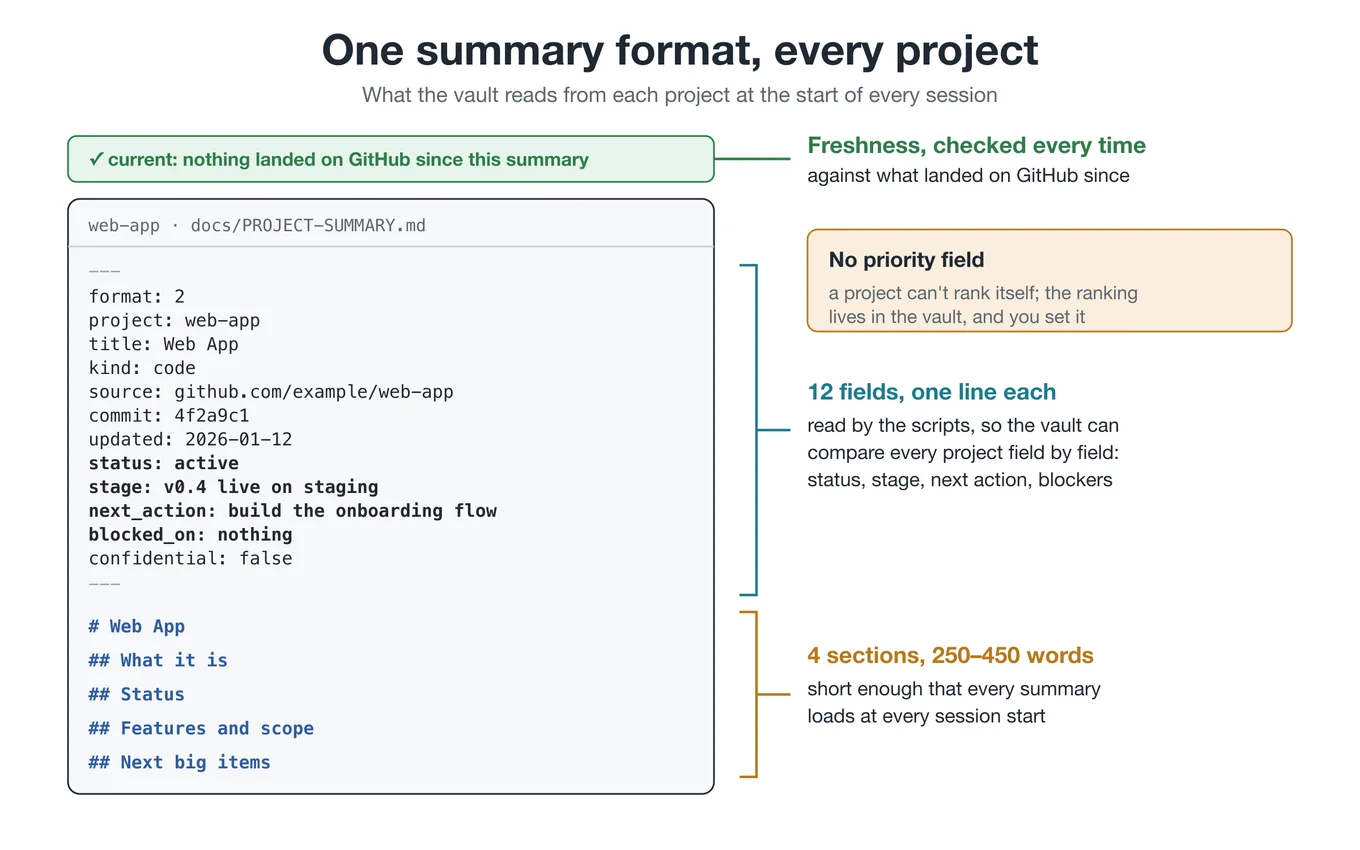
If this sounds familiar, it is the same idea as the 4W + 2H itself. When my team and I were receiving more than 100 emails per day, a common format allowed the recipients to compare the requests, forced the senders to simplify, and let the team catalogue everything. The project summaries do the same for the coordinating agent, and for me (note: the agent is a far more patient reader than I was with those emails :-) ).
To be fair, three of the six missing pieces from Why are deliberately simple. Time management, at least the way I mean it, follows from the ranking: once the projects are ranked with all the facts in front of me, the week's plan and a few written time rules (e.g., one project block a week at most), which apply to everything I work on, do the rest. Cross-project context is for the coordinating agent only, hence a project gets material from the vault only when I choose to give it. Decisions go into a log in the vault, one line each, which the agent searches before reopening something that is already settled (note: my own memory is not always as reliable).
How Much (the cost)
Even though the OneVault agent appears to be doing a lot, i.e., maintaining long memory, cross-project context, decision logs and prioritization lists, the cost is much less than I expected. The tools are Claude Code, git, the GitHub command line (for pull requests only) and a few shell scripts, therefore there is nothing to host. With nine projects, every session starts with about 30 KB of summaries (roughly 7,500 tokens), which is a small price for starting every session already knowing where everything stands. Each rewrite of a summary is one Claude run, on my own plan, and only the stale ones need it.
The View From the Agent's Side
Since the coordinating agent is the one reading the summaries, I asked Claude to describe what the framework looks like from its side. In its own words:
Claude, the coordinating agent
I start every session already briefed. Before you type anything, I already hold nine summaries, each with a line saying whether it is still true, for about 7,500 tokens. So your first question can be about the work ("what should I do today?") instead of the status ("where are we with this one?"), and I don't have to open nine repos to find out.
I notice when your plan falls behind. The summaries stay current by themselves; your plan is written by hand, and it drifts. Once, it still listed a next step that a project had dropped a day earlier, after an experiment. The summary said so and the plan did not, so I flagged it before we planned the week. That check is now part of OneVault: at every session start, a week's plan older than seven days, or a ranking entry older than its project's summary, is flagged until it is brought up to date.
The common format matters more to me than the length. Every summary has the same twelve fields, so I can line up nine projects' stages, next steps and blockers side by side, and see where two of them compete for the same week, without reading nine different kinds of prose.
What I Took From It
Building OneVault confirmed something I had learned when I moved into management, namely that coordinating the work is a job of its own, and that it does not disappear when the ones doing the work are AI agents instead of people. The questions I was carrying for my AI projects were the same ones I used to carry for my teams: where does each one stand, what comes first, why did we decide that, and when will I find the time? Hence, it is no surprise that the answers look familiar as well, e.g., the summaries play the role of status reports and the weekly plan the role of a priorities list. In my opinion AI makes the building faster, however someone still has to decide what is worth building next, and that is still our job (note: at least for now).
Finally, even though I built OneVault for my own AI projects, I had real-world projects in mind from the start and tried to merge the two to some extent. It works just as well for projects people run: the summary agent writes from what landed in the repo, whoever did the work, so a manager can point it at each team's repos and get a current status without asking anyone for a report (and without becoming the single point of failure again). I truly believe its biggest value is with multiple human teams. If you manage a team, point it at your team's repos and tell me what happens; that is the test I am most curious about.
OneVault is open source, and the installation walks you through everything, even if you have no vault yet. It is far from perfect, so I would love to hear how others handle the same problem, or where this approach breaks; feel free to open an issue on GitHub or reach out directly. There is also a page with the full picture, with a diagram for every part.
Notes
- Note-1: Coordination does not equal control. The vault does not run the projects; it reads them, it owns only three things (the list of projects, the format of the summaries and the ranking), and it changes a project only when I ask. Each project remains the source of truth about itself. ↩
